
Linn County Criminal Court Cases
Linn County sits in Missouri’s Ninth Judicial Circuit. The Circuit Court is the felony trial court. Its associate circuit division handles assigned misdemeanors and local municipal matters, including Brookfield ordinance cases. This split matters when a search returns an associate division entry for conduct that did not begin as a felony. A city caption can also appear even though the record is administered through the county circuit system.
The Circuit Clerk keeps the filed case record at 108 N. High Street in Linneus and answers at 660-895-5212. The office is the source for docket inspection, certified judgments, older files, and public papers that are not available online. Brookfield’s official court material lists Amber Boley as clerk, but officeholders can change. Confirm the current clerk through Missouri Courts before relying on a name. Court staff may explain how to find or copy a Linn County case, though they cannot advise a party what to file.
Linn County Ninth Circuit Divisions
The charge level helps route a Linn County criminal case. Felonies proceed in Circuit Court, while assigned misdemeanors usually remain in the associate circuit division. Missouri law classifies felonies from A through E and misdemeanors from A through D. The class shown beside a charge describes the statutory grade, not the final result. Intake wording from an arrest can change after prosecutor review.
Brookfield adds a local wrinkle. Its municipal court is a division of the Linn County Circuit Court, and the associate circuit judge hears alleged city ordinance violations. Published city material places that session on the courthouse’s third floor one Tuesday each month at 9:30 a.m. A Brookfield municipal caption therefore does not signal a separate online court portal. Search the circuit system, then call the clerk when the session, division, or document location is unclear.
Searching Linn County Case Records
Missouri Case.net is the free statewide starting point for Linn County case records. It supports litigant, filing-date, case-number, scheduled-hearing, and judgment-index searches. A narrow Linn County location filter cuts false matches. Names can vary, so use the exact case number from a citation, bond paper, or prior docket whenever it is known.
- Open Case.net and select the search mode that matches the identifier in hand.
- Choose Linn County or the proper Ninth Circuit location, then select a criminal or municipal case type.
- Enter the party name, filing range, or exact case number. Try careful spelling variants if a name search fails.
- Open the case detail and review charges, docket events, hearings, judgment, sentence, and public financial entries.
- Call or visit the Circuit Clerk for a missing scan, older file, plain copy, or certified judgment.
| Field Label | Type | Required | Notes |
|---|---|---|---|
| Search mode | Tabs or links | Yes | Choose name, filing date, case number, hearing, or judgment index |
| Court | Dropdown | For a narrow search | Select Linn County or the relevant Ninth Circuit option |
| Last or business name | Text | Name mode | Spelling differences can alter results |
| First and middle name | Text | Conditional | Helps separate people with similar names |
| Case type | Dropdown | No | Limit results to criminal or municipal matters |
| Case number | Text | Number mode | Use the exact court number when available |
Linn County Case.net Search Modes
The official Case.net search screen shows how Missouri separates known-name searches from date, number, hearing, and judgment queries.
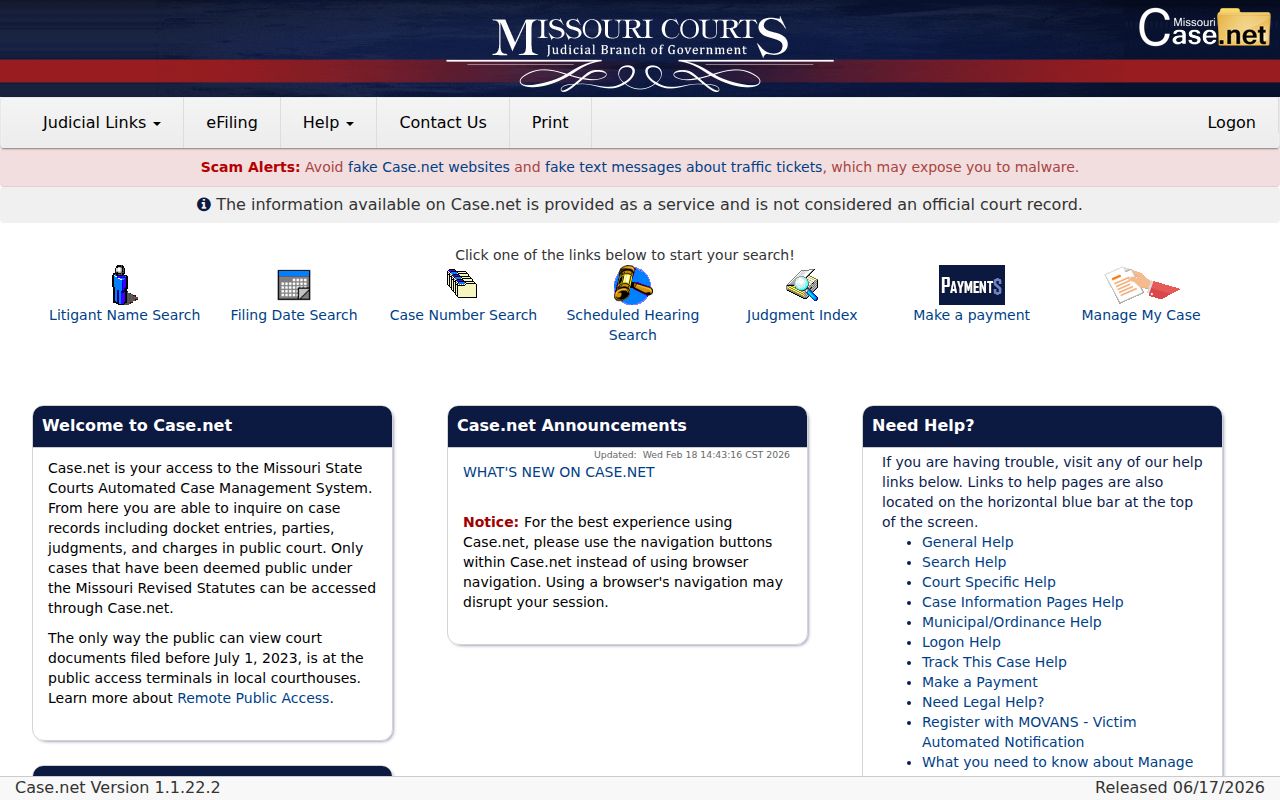
Those modes solve different problems. A litigant search is broad and may return similar names. Filing-date search helps when the event date is known but the court number is not. Scheduled Hearings and Trials can confirm the next public setting, while the Judgment Index is not a substitute for reading the full case detail. Missing images may reflect remote-access limits, not a missing document.
Identity checks need care. A display name alone does not prove the docket belongs to the intended person. Cross-check the court, filing date, case number, charge, and other lawful public identifiers. Case.net updates docket information, but an entry can use terms that describe case administration rather than guilt. The final judgment is the best court source for the outcome.
Inside a Linn County Case File
A Linn County court file begins when a prosecutor files a complaint or information. An information is a formal charging document filed by the prosecutor. The public case view can then connect that filing to the parties, hearings, motions, plea, judgment, sentence, and court finances. It does not usually reproduce the officer’s full incident narrative, dispatch material, or evidence held by law enforcement.
| Case Number & Court | Unique court identifier, filing location, division, case type, and current status |
|---|---|
| Charging Document | Filed allegations, cited statute or ordinance, and charge class |
| Docket Entries | Chronological filings, summons or warrant events, counsel entries, motions, pleas, and orders |
| Hearing Dates | Public date, time, place, division, and hearing type when scheduled |
| Disposition & Judgment | Dismissal, plea, verdict, judgment, or other final treatment of each count |
| Sentence & Conditions | Custody, probation, fines, costs, and other terms entered by the court |
Read each count on its own. One count may be dismissed while another ends in a guilty plea. Financial entries can show costs or fines, but a balance does not by itself explain the disposition. If a certified outcome is needed, give the clerk the case number, party name, document title, and approximate filing date, then ask for a fee quote.
Linn County Disposed Case Meaning
“Disposed” means the court has completed a procedural stage or closed the case in its docket. It does not always mean “convicted.” A Linn County case can be disposed by dismissal, acquittal, guilty plea, trial judgment, or another court action. Open the charge-level disposition and judgment entries before describing the outcome.
Another Missouri term is suspended imposition of sentence, often shortened to SIS. With an SIS, a court may accept a plea or finding but suspend the formal imposition of sentence while probation is active. Missouri’s public MACHS response may display that cycle during active probation, then the record can become closed when statutory conditions are met. Court visibility follows separate court-access rules. Comparing a Case.net judgment with the repository cycle helps expose an outdated or incomplete disposition.
How a Criminal Case Moves
Law enforcement may investigate, make an arrest, or seek a warrant. The Linn County Prosecuting Attorney then reviews the referral and decides whether to file charges. If a complaint or information is filed, the clerk creates the court case. An initial appearance and bond decision may follow. Felony preliminary proceedings can begin in an associate division before the matter proceeds in Circuit Court.
Case flow: Charges Filed › Arraignment › Pretrial › Plea or Trial › Disposition › Sentencing
Pretrial docket events can include counsel appearances, discovery, motions, continuances, and hearing settings. A plea may resolve some or all counts. A trial leads to a verdict, while a dismissal ends a charge without a guilt finding. After judgment and sentence, the clerk reports the disposition to the Missouri State Highway Patrol Central Repository. The sheriff still keeps its own arrest and booking material.
Linn County Charging Record Flow
The Linn County Prosecuting Attorney’s official page identifies the separate office that receives law-enforcement referrals and handles filed state charges.
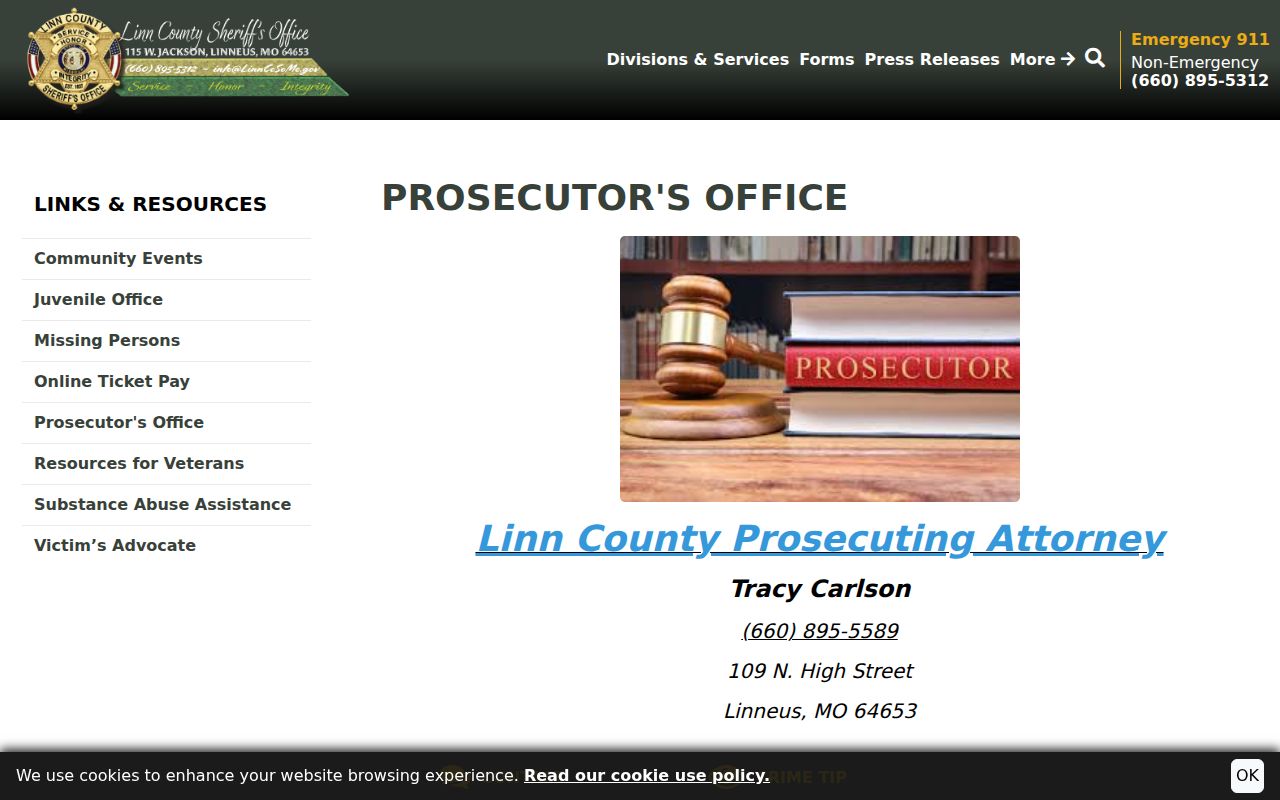
That separation explains why an arrest allegation, prosecutor-filed charge, and court disposition may not match word for word. The prosecutor can decline a referral, file a different count, amend a charge, or dismiss it. The court record becomes authoritative for adjudication only after filing. Tracy Carlson is listed as Linn County Prosecuting Attorney at 109 N. High Street, Linneus, with 660-895-5589, but the office does not replace the clerk’s public case file or give personal legal advice.
When no Linn County case appears soon after a booking, first confirm the spelling, location, and case type. The prosecutor may still be reviewing the referral, or a city matter may be filed under a municipal caption. For current custody, use the county’s arrest lookup channels. For a filed charge, return to Case.net or ask the clerk whether a number exists.
Linn County Certified Case Copies
A screen view is useful for research, but it is not a certified court copy. Ask the Linn County Circuit Clerk for a certified judgment when the seal or clerk’s certification matters. Supply the exact case number if possible. Also give the party name, approximate year, and precise document sought. Ask whether a plain, certified, or authenticated copy fits the need and request the current fee before ordering.
In-person inspection is the fallback for older or non-digitized public files. The courthouse counter is at 108 N. High Street, Linneus. Published Brookfield court material lists weekday courthouse hours from 9 a.m. to 5 p.m., excluding state holidays, but callers should confirm the specific counter before travel. A missing scanned pleading is not proof the pleading was never filed. It may be available only at the counter or subject to a remote-access rule.
Case Record Access & Restrictions
Missouri’s Sunshine Law favors access to public government records, but court files also follow Missouri Supreme Court operating rules, sealing orders, and remote-access limits. The Missouri Courts public-access overview explains the distinction between case information and records available for remote review. Juvenile matters, sealed or expunged cases, protected victim data, and confidential identifiers can be withheld or redacted. A public docket line does not guarantee that its linked filing is open online.
If a Linn County record is absent, ask the clerk whether the case exists under another caption, division, or year. Request the public, nonexempt portion rather than assuming the whole file is closed. When a repository cycle lacks its final outcome, obtain the court judgment and use the Missouri State Highway Patrol CJIS correction process. The court judgment, arrest report, and statewide criminal-history response are distinct records, so fixing one source may not automatically fix the others.